November 21, 2014

Luxemburg - the Alzette

Grand Duchess Charlotte, who was also
second-cousin of my favourite Swedish
King, Gustav VI Adolf. 
The first count of Luxemburg was Sigefroy, or Siegfried, formerly of the Ardennes. According to the legend, he once visited the old Roman fort that was situated on the hill where Luxemburg is today, and found a beautiful girl among the ruins. She agreed to marry him, but she could never leave the cliffs, she said, and she had to be alone every Saturday. Sigefroy agreed, exchanged his land in Ettelbrück for the cliff over and the valley of the Alzette river, and settled down with the girl, Melusina, in a brand new castle.

Of course, he one day had to peek through the keyhole, to see what she was doing alone in her chamber on Saturdays, and what he saw horrified him: she was in her bath, and instead of legs, she had a fishtail! Turns out, pretty Melusina was a mermaid. When he had realized that, the spell was broken and Melusina disappeared into the Alzette river forever. Or not exactly forever; it is said that she returns every seven years in an attempt to find a new lover who can free her from the river.

Some say the old name of Sigefroy´s castle, "Lucilinburhuc", alludes to him having had to sell his soul to the devil (Lucifer) in order to get Melusina. I doubt that the current Grand Duke counts his lineage that far back (we are talking 900´s), but it would be kind of cool to claim a mermaid as one´s foremother, wouldn´t it?
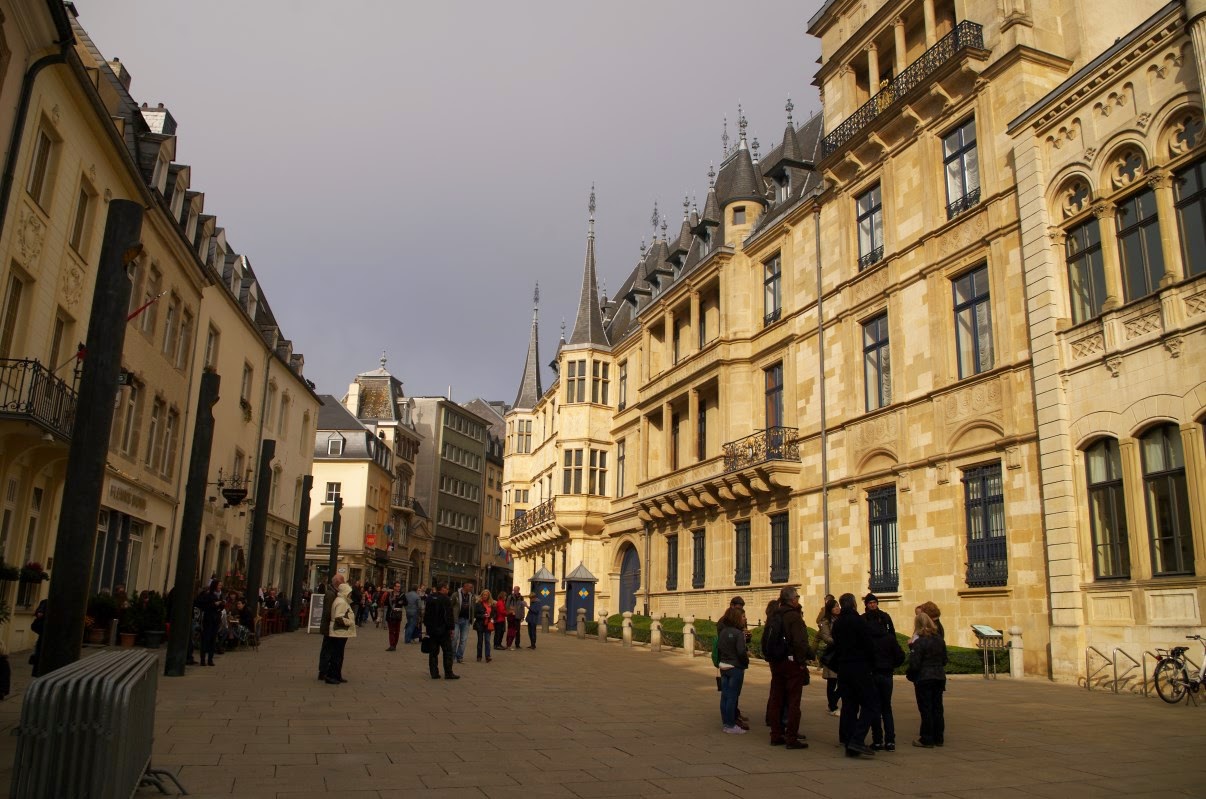
The Grand-Ducal Palace to the right.
The current Grand Duke is Henri, and he is the grandson of the very popular and loved Grand Duchess Charlotte, who has a very nice statue erected for her in the middle of the city. She was actually elected head of state after her older sister, who had been ruling Luxemburg during the First World War, was forced to abdicate. The sister´s politics was not appreciated by her people (she supported the German occupation).

During the Second World War, Charlotte led an exile government in London, and remained loyal to her people, opposing the Germans (I also imagine this would have been easier for her than for her sister as Germany was no longer a kingdom but a republic, thus there being no royal kinships to consider). Her son Jean, the next Grand Duke, took part in the Normandy landing, the battle of Caen and the liberation of Brussels, as a volunteer officer in the Irish Guards.

This little girl decided to join the guards and march up
and down in front of the palace gate. 
We had a lovely day walking along the river, we and many others out for a holiday stroll. There was even a bit of sun! Really, this is a wonderful place for a little getaway, if you prefer holidaying in a city, but one that is not quite as buzzing as say, London or Paris.

It occured to me, as we were walking along the river, looking up at the city, that the Melusina legend is a wonderful allegory for that fragile balance of interdependence between a ruler/protector and his people, the knights in the castle and the folks below, living off the Alzette river. It is a small country, and I imagine a large part of the population is acquainted first hand with the royals. A tight and fond relationship, or so it seemed to me.


View over the Red Bridge, or Grand Duchess Charlotte´s Bridge.

There is an interesting mix of old architecture and some very modern, good
architecture that really looks wonderful.

A bit of lëtzebuergesch: keep our city clean.

Really, there is so little water in the Alzette that it´s quite hard to believe any mermaids still reside here. I suspect Melusina has moved on. 


We found a pub in precisely the right location to slake our thirsts.

A real fire, no less, and the mantlepiece says "Rest in Peace" -
we suspect it was made from a discarded gravestone... Fitting, though!

This is the state of the Petrusse river - barely more than a ditch.

This fancy building is often mistaken for the Grand-Ducal Palace, we were told. However, it is a bank. 


November 17, 2014

Ella & Pitr

This is just too cool! I thought it was someone painting on a photo at first, but it´s not, it´s real life paintings made to look, well, I don´t know what to say! Can´t find much more about the artists than this. Amazing.

I wouldn´t see as much great art as I do if I didn´t subscribe to Faith is Torment.

November 14, 2014

Art on Nature

I passed the art gallery the other day and popped in to have a look. Two artists were on display, and they were so very different. On the one hand, Janolof Bengtsson with an exhibition called "Rent måleri" (= pure painting), abstract images with titles like "Forest today", "Beyond the hills" and "Mercy". It feels like landscapes to me, and remind me much of Monet´s paintings of his pond and flower garden.

Bengtsson says on a website for Kvirr (an association of artists from northern Bohuslän, which is in the south of Sweden) that he processes his impressions of nature in his art. The landscapes on the canvas are inner landscapes, but they have their origin in the outer landscapes. It seems to me that this is as close to the Swedish soul as one can get. It is lovely, really. A lot of these paintings had been sold, and I don´t wonder.

The other artist on display was Aron Rantatalo, a local artist whose exhitibion is called "Transition". It´s a mix of painting, collage and sculpture, and the most eery thing is this life-size cast/doll where he has turned himself into a Monchichi. Remember Monchichis? They were little dolls that were all the rage when my youngest sister was little. Perhaps Rantatalo is the same age, 40 or thereabouts.

The overall theme here is man and animal, and he says in this article he is interested in "animalisering", which leads me to a Wikipedia article in Dutch (I think) that defines it as the creation of figures that are a bit of both, like mermaids. Personally, I think of the Germanic pagan belief that each person had his or her own fylgja, which was a kind of totem, an alter ego in the animal world, as it were. An animalisation of one´s soul, perhaps.

Sorry about the photos being so crappy, I just had my phone camera on hand and it really isn´t very good. I can´t find that any of these artists have their own websites.


November 13, 2014

Animationals, or what?

You just have to take a look at what Sarah DeRemer is doing. Those animals she has dreamed up are too real, too spooky. The dogsnake is probably my favourite. Or maybe this birdwhatever.

November 10, 2014

Excursion into the Ardennes

One nationality seem more welcome in Luxemburg than any other: the Americans. We saw so many memorials to the victims and the heros of the Second World War, and the Americans are celebrated as the liberators.

Since we are very interested in the history of this particular period, we decided to go north, to the Ardennes and its capital Wiltz, where there is a museum dedicated to the Battle of the Bulge, or the Ardennes Counteroffensive, as we usually think of it.

Unfortunately it wasn´t clear from the website that the museum was closed, so we travelled for an hour by train to be met by a locked door. Not that it got us down much. Heck, we were on vacation, and we got to see the Ardennes! We even saw an Ardennes horse from the train - which was too fast for us to get a snap of it, but if you don´t know them, they look like this.

We ended up taking a walk around the small town of Wiltz, lit a few candles in the church, walked back to the train and returned to the capital, where we had - of all things - a Mexican meal with a Belgian beer, a mix of beer and blackberry juice. Odd, but so good I drank two.

The monument on Constitution Square.


The Ardennes from the train window. We followed the valley and the river, what a wonderful landscape - even the mist felt just right!

The houses are typically plastered and topped with slate roofs from local quarries. The roofs often covers the top two stories on larger houses, and the shape of that church tower roof you see, a rather flat slope that surrounds a steep needle-like spire, was everywhere.


The war monument in Wiltz. 


This is in honor of general Eisenhower, who personally liberated Wiltz.

My favourite memorial: to Richard Brookins, American GI who decided to be St Nick to the children of Wiltz at Christmas 1944. He was made honorary citizen of Wiltz; he died in 2009. 

Memorial to the Battle of the Bulge.

The Town Hall.

The castle of Wiltz, now a cultural centre and our destination, the museum that turned out to be closed.

The city centre.

The local church.

Wiltz on the other side of the tracks. The houses are rather colourful, don´t you think?

November 9, 2014

Luxemburg - the Location.

The city is so well captured on this stained-glass window
at the Central Station.
The first impression one gets from Luxemburg (the city, that is, Luxemburg is also the name of the country, which can be a bit confusing) is that it´s situated in a quite awkward place, for a modern city. Of course, it must have totally made sense in the very beginning: two rivers meet here, the Alzette and the Petrusse, and if you consider the spectacularly deep valleys they have dug into the ground, they must once have been pretty much more impressive than they are today and this must have been a natural place to meet and trade. The Petrusse is today barely more than a ditch.

Above the river valleys is the old town, with what is left from the old fortress that defended this place. When the Spanish ruled here in the 17th Century, they started digging into the sandstone cliffside to make casemates, which is basically caves with guns in them. This work was continued by the subsequent rulers like the French, Preussians, Habsburgers, and in total there is 23 kilometers of tunnel under the city, most of which is closed off now. Some, however, is open to the public and naturally, we had to take a look.

This is the Passerelle, or the Old Bridge, or the Luxembourg Viaduct (must be loved, with so many names), which we had to cross to get into the city centre - our hotel was only a stone´s throw from the Central Station, on Rue de la Gare.

Constitution Square is built on top of old fortifications.
There are casemates underneath, but they only let you in on guided tours.

The Pont Adolphe from 1903 is a quite famous bridge (not that I had ever heard of it...), but it was being renovated. It looks like this underneath the bandages.

This part of town is called Grund, a German word that means foundation.
This is below the fortress, where the rivers meet,
probably the whole reason for Luxemburg being where it is, so the name is apt.

The casemates from outside.

The casemates from inside.


The red bridge, or The Grand Duchess Charlotte Bridge, viewed from the casemates. One has to cross it to get to the airport and Kirchberg, which is the location of the EU institutions of Luxemburg. 

The railway bridge. The bridges really have a profound impact on the landscape .